
Deferring the Descent
How Technology Industrializes the Avoidance of Transformation

A companion to “The Necessary Descent”
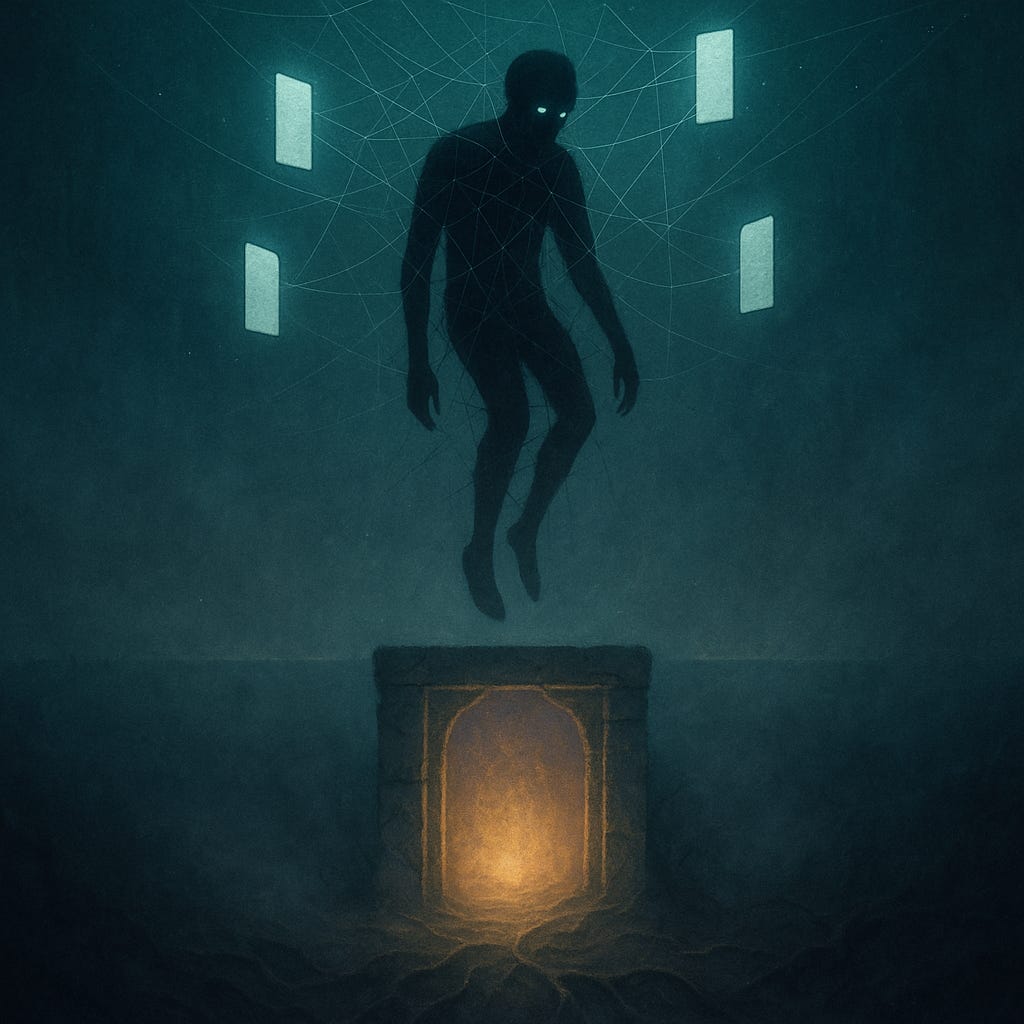
We live in an age of potentially infinite deferral. Every moment that might call us into the necessary darkness of transformation can now be postponed with the flick of a thumb. The notification chime, the endless scroll, the next episode automatically queuing—these aren’t just distractions. They’re sophisticated technologies of avoidance, keeping us suspended in a liminal zone between authentic living and the death-like descent that authentic living periodically demands.
In the “The Necessary Descent” I explored how wisdom requires alternating cycles of complexity and deconstruction. We must periodically descend into the darkness to refactor our foundations for the greater complexity life is calling us toward. But what happens when a culture develops technologies specifically designed to prevent that descent? What becomes of a civilization that has industrialized the deferral of transformation?
The Suspended Middle Ground
Neil Postman, writing in 1985’s “Amusing Ourselves to Death,” warned of a future where we would be controlled not through the overt oppression Orwell imagined, but through entertainment. “What we love will ruin us,” he wrote. His prescient vision has materialized beyond his wildest imagination. We now carry in our pockets devices capable of delivering infinite entertainment, endless information, and constant stimulation designed to capture and hold our attention.
But Postman’s analysis, profound as it was, focused primarily on television’s passive consumption. What we face now is far more sophisticated. Interactive technologies don’t just amuse us. They actively study our patterns of avoidance, learning precisely which stimuli will keep us from turning inward when the call to descent arrives.
These technologies create what we might call a state of perpetual suspension. We remain technically active, responsive, engaged with surfaces, but systematically disconnected from the depths where real transformation occurs. We exist in a kind of animated limbo: functional enough to meet our obligations, yet never fully present enough to feel the friction that would signal the need for deeper change.
Consider the phenomenology of this state. You sense something stirring beneath the surface. A dissatisfaction, a question about your life’s direction, a recognition that something needs to change. In previous eras, this stirring might have led to contemplation, conversation, or simply sitting with the discomfort until it revealed its message. Now, within seconds, you can deflect that stirring into a feed, a game, a video, a scroll through others’ curated lives.
The mechanism is elegant in its effectiveness. The moment we begin to feel the call toward depth, toward questioning, toward the necessary falling apart, technology offers us a more comfortable alternative. We can live indefinitely in this middle space. Never quite facing what needs to be faced, never quite avoiding it entirely, suspended in a kind of psychological purgatory.
What makes our current situation unprecedented isn’t just the availability of distraction but its optimization. These platforms don’t simply offer entertainment. Their algorithms function as what Tristan Harris calls “a supercomputer pointed at your brain,” studying our patterns of avoidance and delivering precisely the stimuli most likely to capture our attention.
To be clear: I’m not suggesting all technology use serves this function. Using video calls to maintain genuine connection with distant loved ones, engaging with educational content that expands understanding, creating art with digital tools: these represent technology in service of consciousness and relationship. The pattern I’m pointing to is more specific. I mean the use of interactive media to systematically defer the moments when our depths call for attention, when transformation knocks at the door.
The result is a culture of technologically mediated dissociation. Millions of people present enough to function and consume, but systematically disconnected from the deeper currents of their own experience. The very technologies we use to “connect” serve to disconnect us from ourselves.
The Symptoms of Deferred Descent
When natural cycles of death and rebirth are consistently deferred, the psychic energy that would normally flow through these transformational processes doesn’t simply disappear. It manifests in other ways, often more destructive and less conscious than the voluntary descent would have been.
James Hillman, in “Suicide and the Soul,” proposed that suicidal impulses often represent the soul’s demand for transformation. He saw them as a recognition that some aspect of our current way of being needs to die for new life to emerge. This isn’t to romanticize or minimize the very real crisis of suicide, nor to suggest that suicidal feelings should be interpreted away rather than taken seriously. Clinical depression and suicidal ideation require proper treatment, including medication when appropriate.
What Hillman offers is an additional lens. Beneath the literal despair may lie a symbolic truth: something in how we’re living needs to end. The question becomes whether this ending can be metabolized symbolically through voluntary descent, or whether it remains trapped in the literal register where it threatens our physical life. When we lack cultural containers for voluntary psychological death and rebirth, the soul’s legitimate demand for transformation can become conflated with impulses toward literal self-destruction.
Consider the epidemics of our time through this lens. The rising suicide rates, particularly among young people. The cultural obsession with apocalyptic narratives and collapse scenarios. The proliferation of zombie media and post-apocalyptic entertainment. The appeal of “ending it all” fantasies whether personal or civilizational. These phenomena might be understood, in part, as the collective unconscious expressing what our technological deferrals have made individually inaccessible: the recognition that something needs to die for something new to be born.
The popularity of zombie narratives is particularly revealing. These stories fascinate us not randomly but because they mirror something about our condition—figures that appear alive but lack genuine consciousness, that consume without nourishment, that move through the world animated by hunger but incapable of satisfaction. We’re drawn to these images because they reflect what we fear we’re becoming: technically functional but existentially hollowed out.
The Impossibility of Voluntary Descent
In previous eras, descent was often forced upon people by circumstances. Illness, loss, economic hardship, or social upheaval would create conditions where the usual strategies of avoidance became impossible. People were compelled by external circumstances to face what they might otherwise have avoided.
Our technological culture has created unprecedented capacity to avoid such reckonings. Economic hardship can be masked by credit and entertainment. Social isolation can be filled by social media. Existential emptiness can be numbed by endless content. Even grief and loss can be medicated or distracted away. But these are all temporary measures. Deferrals, not resolutions.
These technological deferrals don’t resolve the underlying call for transformation. They simply postpone it while often making it more urgent. Like a pressure cooker with a blocked release valve, the energy that would normally flow through voluntary descent builds up until it eventually finds expression in less conscious and potentially more destructive ways.
The person who cannot voluntarily descend when called may find themselves involuntarily collapsed by circumstances that could have been avoided through earlier, conscious engagement with their own transformation. The relationship that could have been saved through honest reckoning with personal patterns instead deteriorates through avoidance. The career that could have been redirected through conscious choice instead becomes a source of chronic dissatisfaction and burnout.
What makes voluntary descent seemingly impossible isn’t that the capacity has disappeared but that the conditions supporting it have been systematically eroded. We’ve built a civilization optimized for constant activity and surface engagement, one that treats any withdrawal from productivity as suspicious or pathological. The very structures we depend on (jobs, social expectations, the rhythm of daily life) make it extraordinarily difficult to create the space and time that conscious transformation requires.
The Cultural Stakes
The implications extend far beyond individual well-being. A culture composed primarily of people unable to voluntarily face their own transformation needs becomes a culture incapable of adapting to changing circumstances. The same technological systems that help individuals defer necessary personal evolution also create collective blindness to the need for cultural and social transformation.
We see this playing out in our response to ecological crisis, social inequality, and technological disruption. Rather than engaging with these challenges as calls for fundamental transformation in how we organize society, we often treat them as problems to be solved through more technology, more efficiency, more of the same approaches that created the problems in the first place.
The technological deferral of individual descent becomes the template for cultural deferral of collective reckoning. Just as individuals use devices to avoid facing personal truths, societies use technological solutions to avoid facing systemic contradictions and unsustainable patterns.
The Call Continues
Despite our unprecedented capacity for deferral, the call to descent continues. It manifests in anxiety, depression, addiction, and the various symptoms of lives lived in partial contact with their own depth. It shows up in the cultural phenomena I’ve described—the fascination with apocalypse, the epidemic of suicide, the zombie aesthetics of our entertainment.
The soul’s demand for transformation doesn’t disappear simply because we’ve created sophisticated technologies for avoiding it. If anything, the energy builds and intensifies when consistently deferred, eventually expressing itself in ways that are harder to ignore and potentially more destructive than voluntary engagement would have been.
Our technological deferrals have created a culture-wide spiritual emergency—millions of people simultaneously called toward transformation but systematically prevented from responding to that call. The resulting tensions show up everywhere: in our politics, our mental health statistics, our environmental crises, our social fragmentation.
The Choice Before Us
We stand at a crossroads. We can continue developing ever more sophisticated technologies of avoidance, creating a culture of developmental limbo where transformation is eternally deferred. Or we can begin to use our technological capacities in service of consciousness, creating tools and systems that support rather than subvert our natural rhythms of growth and transformation.
This choice will determine whether our technological civilization evolves into something more wise and sustainable or continues its current trajectory toward increasing brittleness and eventual collapse. A culture unable to voluntarily descend when transformation is called for will eventually find that descent imposed upon it by circumstances it could have avoided through earlier, conscious engagement with the need for change.
The path forward requires both individual and collective choices. Personally learning to recognize and respond to the call for descent despite technological temptations to defer it. Collectively creating the cultural containers that make voluntary transformation safe and supported.
Most fundamentally, it requires recognizing that our technological powers, unprecedented as they are, cannot eliminate the basic rhythms of human development and spiritual growth. We can defer descent, but we cannot avoid it indefinitely. The question is whether we’ll choose conscious engagement with transformation or have it forced upon us by accumulated consequences of our avoidance.
The necessary descent waits for no one. It can be postponed, deferred, medicated, and distracted away, but only temporarily. Eventually, what needs to die must die, and what needs to be born must be born. Our choice is not whether this transformation will happen, but whether we’ll meet it consciously or unconsciously, voluntarily or by force, individually or collectively, as wisdom or as crisis.
The devices in our pockets can defer the descent, but they cannot provide what descent offers—the possibility of emerging on the other side more whole, more real, more capable of love and wisdom than we were before. That gift remains available only through the voluntary embrace of what our technologies work so hard to help us avoid—the periodic death of who we’ve been in service of who we might become.
Philosophical foundations: This piece draws upon several wisdom traditions explored in my Lineages of Inspiration article, which outlines the key influences shaping my understanding of human transformation.
Work with me: I offer one-on-one guidance helping people develop secure attachment with reality through deep unfoldment work. If this resonates, explore working together
Deferring.
Great read. I definitely have felt the sense of distraction growing in the last few years. I also notice that there is generally more conversation around mental health, compassion, kindness and self-awareness - so that seems positive. I also wonder if there's a flip-side to this - as more people are openly using AI for healing/therapy/spiritual work, this doesn't necessarily require new infrastructure, but it's rather more about how we use it which you've mentioned in some of your writing on AI and spirituality.