

This piece explores attunement as the catalyst for healing, building on the framework I established in "The Essence of Healing" and "The Architecture of Safety." While safety creates the foundational container where healing becomes possible, attunement provides the exact precision of presence that allows transformation to occur. Here, we dive into what attunement actually is—and why generic love and care, however sincere, often aren't enough to unlock our deepest wounds.
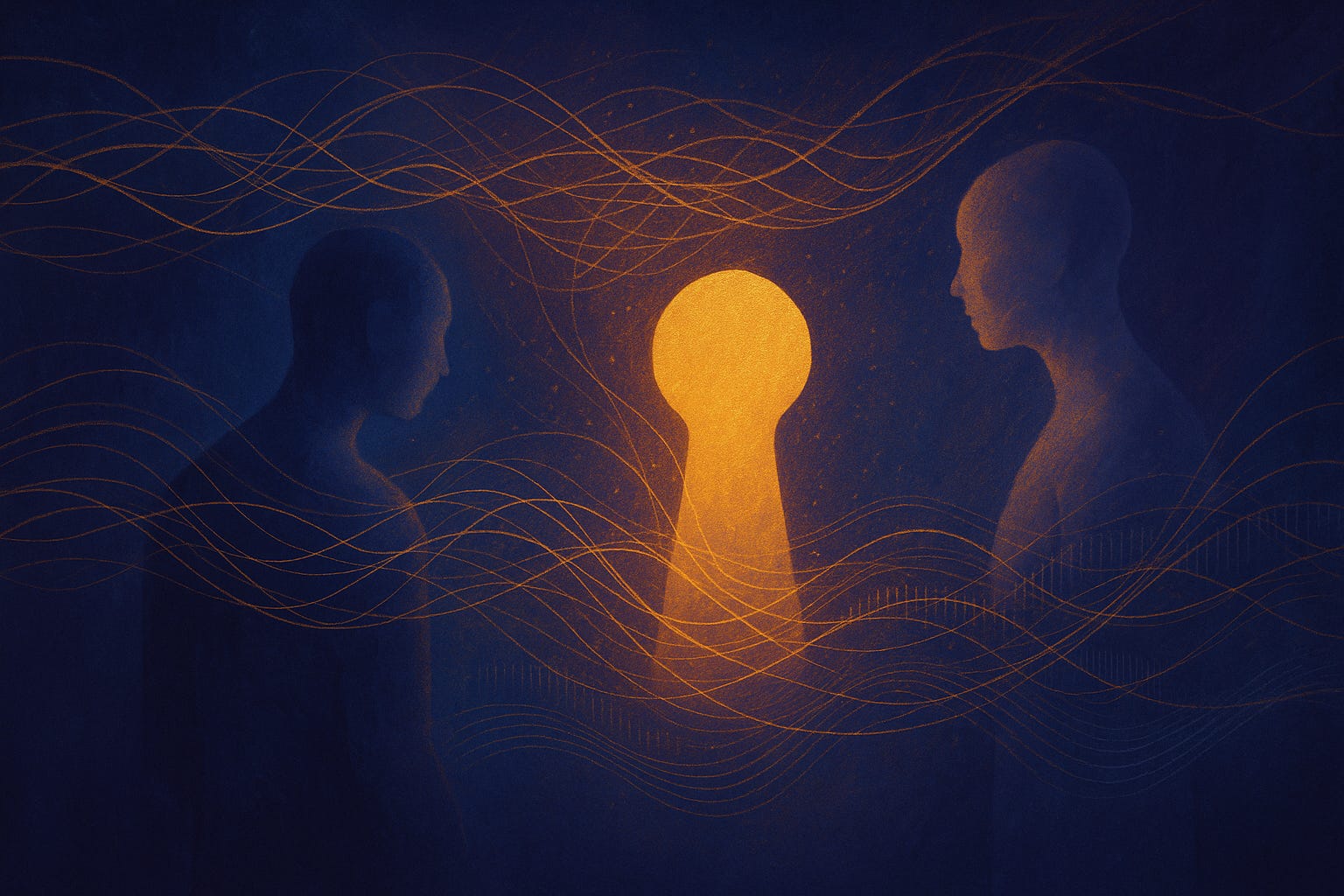
For weeks, a particular flavor of anxiety persisted in my system. I offered it presence, did parts work with it, meditated with it, and shared it with others as best I could. But it didn't begin to shift until I approached it differently. I began being with it as one might approach a scared, small, defenseless animal—moving toward it slowly, hands outstretched and open, speaking softly and reassuringly.
When I made this shift, an immediate alchemical response occurred. It was as if this creature inside me could finally receive the nutriment it had been wordlessly crying out for all along.
In my previous writing, I explored how safety creates the foundational container for healing. But there's something else required, something I've come to see as the difference that makes the difference. That something is attunement—presence refined to match exactly what's asking to be met.
Many of us can feel generically safe in a supportive community, with a caring therapist, surrounded by friends. Yet we still find that our deepest wounds remain hidden. This isn't a sign of insufficient care; it's the recognition that healing requires something more nuanced: the capacity to feel another's experience so precisely that what's suffering can finally feel itself being felt.
What Attunement Is
Attunement isn't cognitive understanding, though understanding may arise from it. It isn't generic care or love, though both may be present. Attunement is the precise, embodied resonance with what's actually present: the capacity to match and appropriately respond to not just the content of suffering but its vitality, rhythm, and quality.
Daniel Stern's research revealed this as "cross-modal matching"—the way a mother might respond to her infant's excitement with vocal sounds that match the energy and contour of the child's movement. In healing work, attunement becomes the capacity to feel into the exact texture of experience and reflect it back so accurately that what is suffering finally feels met.
If we are willing to listen, our suffering teaches us exactly what kind of love it needs. When the right quality of attunement is offered, there's an immediate recognition. It's like a key finding its lock, or a crying infant finally feeling the exact embrace it needs. The transformation is felt throughout the body as a profound shift, a releasing, an integration that reorganizes the whole system.
Why Precision Matters
Let me share a story from my own healing journey that illustrates why this precision matters so much.
Despite practicing with skilled practitioners and friends who were holding space for me with sincerity, a certain pattern in my system remained stuck for months. The material seemed unmovable, and parts of me were beginning to worry that it might never unfold. After every session, the stuckness remained.
Then I started working with someone new. Something in me was drawn to him, though I couldn't articulate why at the time. Looking back, I believe the part of me seeking healing recognized it could receive what it needed from him. What happened next was remarkable: the material that had been intractable for months effortlessly unfolded in his presence.
What was different? All my friends were sincere practitioners skilled at holding space. I can see now that they simply weren't able to offer the precision of attunement necessary for this particular suffering to feel truly met. And because it didn't feel met, it continued to cry out, and I continued to suffer.
This experience taught me that healing isn't just about the presence of love—it's about the precision of that love. Something in my system could recognize exactly what quality of attention it needed, and it would only respond to that specific attunement. No amount of generic care, however well-intentioned, could substitute for the precise meeting my suffering required.
The Alchemy of Precise Meeting
There's a qualitative difference between the mind's attempt to create attunement through cognitive understanding and true embodied, heartfelt attunement. The mind tries to understand in order to help, but this pseudo-attunement will never have the same impact as genuine felt resonance.
When real attunement happens, when suffering meets precisely the right quality of resonant presence, something alchemical occurs. There's an immediate shift throughout the body: releasing, integration, transformation that changes everything.
But what exactly is this "meeting" that creates such profound transformation?
Meeting happens when suffering feels seen, understood, and loved exactly as it is—without any agenda for it to change. It's the moment when what has been hidden or fragmented recognizes itself in the mirror of presence. In true meeting, nothing needs to be fixed because everything is already recognized as whole.
Something in us can sense when the presence being offered genuinely trusts our suffering versus when it secretly wants it to go away. Our systems are exquisitely attuned to this difference. Authentic meeting only becomes possible when there's no hidden agenda for transformation—paradoxically, this is precisely when transformation occurs.
In this quality of encounter, we begin to see ourselves more clearly. True meeting functions as an intimate mirror that reveals dimensions of our interior that have remained hidden even from ourselves. When we feel completely welcomed—shadows and all—parts of us that have been waiting in exile finally feel safe enough to emerge into awareness and transform.
Understanding how this alchemy works helps us make sense of why healing often follows a particular pattern—and why the journey can become increasingly challenging as we go deeper.
The Deepening Spiral
The journey of healing and unfolding moves us progressively into more primordial encounters with imprints of incomplete experiences. At the beginning, this might mean encountering our inner critic—finally turning toward it and listening to what it says instead of being unconsciously driven by it. As we offer the critic the listening presence of attunement, the critic's voice begins to soften. Then we might come into more direct contact with the inadequacy that was always present underneath—the very feeling the critic was working to protect us from.
As we continue this journey, each layer that's integrated leads us into deeper—or we might say earlier—territory. Whereas once saying "I feel inadequate" might have been a profound confession that evoked tears and healing, now we find ourselves swimming in more nebulous, hard-to-define spaces.
My experience, both with my own process and with my friends and clients, is that as we unbind self-construction, identity views, and patterns of feeling at more surface levels, what emerges into consciousness are preverbal childhood, birth-related, and ancestral traumas. At this stage it can often seem like things are getting much worse. These early imprints often occurred before the development of a sense of space and time, so the pain at this depth can feel boundless and timeless.
Interestingly, boundlessness and timelessness are also how people often describe awareness itself—the fundamental nature of being. This is no coincidence. These early imprints fuse into the felt texture of awareness, which is partly why we're afraid to let go completely. On some level, we know that what we're letting go into includes whatever failures of love characterized our earliest experiences. Thus, when we try to 'let go' we run straight into our psyche's protective structures trying to keep us from experiencing the seemingly unbearable pain at the core of our being.
This deepening spiral reveals why the capacity for precise attunement becomes increasingly important as we heal—and why we often need support to navigate these deeper territories.
The Art of Giving and Receiving Attunement
As we work with attunement in our own healing journey, we encounter a crucial recognition: we often cannot give ourselves the loving, attuned presence we need precisely because the contours of our capacity to offer it are defined by that which needs it in the first place.
If we're stuck in inadequacy, then inadequacy is exactly what makes us unable to find loving, attuned presence when it arises. If we carry deep shame about our neediness, we'll struggle to offer tender care to the needy parts when they surface. The very patterns that need loving attunement interfere with our capacity to provide the attunement they require. If we could offer the quality of loving presence our suffering needed, we wouldn't be suffering.
This reveals the art within the practice. On one level, healing follows a simple principle: when suffering meets loving, attuned presence, it naturally unfolds. It's almost a natural law. But the challenge lies in our capacity to offer that precise quality of presence to ourselves, especially when we're at our edge.
While it's possible to develop our capacity for self-attunement through individual practice—sitting with suffering in meditation, when approached skillfully, can teach us how to attune in this way—this path is often more gradual and arduous than being met by another who can offer the precise attunement our suffering needs.
The key to self-attunement lies in understanding what blocks it. One of the main barriers is the presence of parts that want the suffering to go away. These parts are often implicit, operating beneath conscious awareness. When we approach our experience endeavoring to offer attuned presence to whatever is suffering, we often do so through parts that want change or relief. This creates a subtle but crucial distortion: instead of offering presence to what's here, we're offering presence contaminated by our agenda to fix or transform. You cannot fake loving presence, but parts of us will try.
When something is emerging in our psyche that is more than we are able to hold, we're usually well served by seeking support from somebody who has moved through similar territory before. It's generally the case that only people who have themselves reckoned with, explored, and resolved imprints at particular depths can fully meet us in the suffering we find there. As we deepen in the path and our own clarification, the pool of people who can hold us at our edge becomes smaller.
Usually we'll know when we've found the right support because their very presence will naturally evoke whatever material is surfacing, as if it were pushing into consciousness toward the attuned contact they might offer. Once the material has moved in relationship—once it's been precisely met and felt—we often find ourselves more able to offer that quality of attunement to ourselves and others. Receiving attunement teaches us to offer it.
The more unfrozen our system becomes, the more capacity for attunement we discover. As we integrate aspects of our experience that were previously defended against, we deepen our capacity for attunement with others encountering similar territory. Our own unfrozen places become gifts we can offer to the world.
Creating Conditions for Wholeness
Real attunement involves being precisely with what's emerging without trying to change it. It means trusting reality's innate movement toward wholeness even when it manifests as confusion, doubt, or terror. This capacity to attune to essence underneath surface experience is what creates deep safety and makes it safe to fully feel, in all its precision, exactly what is happening.
It can be helpful to understand the essence of consciousness as a field of exquisite sensitivity—a loving awareness in which everything that arises is fully felt, seen, heard, understood, and received. This field of attuned sensitivity isn't something we possess; it's what we fundamentally are. It's the substrate of reality from which we are not separate.
From this perspective, suffering emerges wherever there appears to be fragmentation from this field—wherever some aspect appears exiled from relationship with loving awareness. Healing, then, becomes a movement of bringing what is fragmented back into contact with reality: the field of attuned presence itself.
This is what the Jewish tradition calls Tikkun—the healing of the world through gathering the scattered fragments back into wholeness. In this way we can see attunement as the restoration of intimacy between this field of loving sensitivity and everything that appears to be fragmented from it. Through precise, intimate meeting, what seemed separate discovers its belonging to the whole.
When we recognize this pattern—that healing happens through the return of exiled parts to loving relationship—it reveals something profound about human development: whatever fragmentation we experience isn't our natural state but a response to insufficient attunement, and wholeness naturally emerges when that attunement is restored. Just as a plant depends on water and sunlight to unfold into its unique expression, a human being depends on loving attunement to organize into its fullest becoming.
When a child receives consistent, appropriate attunement, their interior develops in harmony, allowing their unique gifts and capacities to emerge naturally. But when attunement is absent or inconsistent during critical developmental moments, those particular movements become frozen—not destroyed, but suspended, as if waiting for the quality of presence they never received.
These frozen aspects of our development don't disappear; they remain within us like seeds in winter soil, waiting for the right conditions to resume their natural unfolding. This is why certain parts of us can feel remarkably young even decades later. They've been waiting all this time for the attunement they needed to continue growing.
From this perspective, what we call suffering begins to make sense as an intelligent signal. Suffering is the way these frozen parts cry out for the loving attention they require. The anxiety that persisted in my system for weeks was actually a part of me calling for precisely the quality of attunement it had been missing. Once it received that gentle, patient presence, it could finally resume its natural process of integration and growth.
Beyond Individual Healing: The Movement Toward Wholeness
From this understanding, we begin to see that what we call healing is actually something much larger than our culture typically admits. Once we recognize this pattern in our own lives—how fragmented parts return to wholeness through attuned relationship—we can't help but see it everywhere: in families where cast-off members are welcomed back, in communities that integrate rather than exile their differences, in movements that heal rather than perpetuate division.
This recognition naturally leads to larger questions such as: What would a civilization look like that was organized around integration rather than fragmentation? How might we design economic systems that attune to and care for what has been discarded rather than endlessly extracting and consuming? What if our approach to social problems—from addiction to crime to mental illness—was based on bringing exiled aspects back into loving relationship rather than further punishment and isolation?
The truth is, there is no such thing as individual healing. What we call personal transformation is always the restoration of relationship—with disowned parts of ourselves, with others, with the living world. Healing isn't about fixing the isolated self—it's about remembering our belonging to the whole.
This belonging reveals itself as nested wholeness: sacred world reveals itself as a symphonic wholeness: whole parts within whole individuals within whole communities within whole cultures within whole civilizations within a whole planet. The movement of healing ripples through all these levels simultaneously. When we offer loving attunement to suffering, we're participating in the same movement that can transform our families, communities, and world.
This way of seeing can transform how we approach both our own healing and our relationships with others. We begin to recognize that every expression of suffering—whether in ourselves, our children, or our communities—represents some aspect of life calling out for the attunement it needs to continue its journey toward wholeness.
Perhaps this is what we're really here for: to become conscious participants in reality's endless project of gathering itself back together. Each time we meet suffering with precise love, we're helping the universe remember its own wholeness.
In this way we align ourselves with something as fundamental as gravity—life's persistent movement toward wholeness. The same force that draws plants toward light and heals our bodies when injured is what flows through genuine attunement. Our task isn't to make healing happen but to learn how not to obstruct it.
The invitation, then, is both intimate and vast: to become so skilled at loving what is broken that we become agents of integration wherever we go. This is the true alchemy—not turning lead into gold, but returning what has been exiled to its rightful place in the whole.
Philosophical foundations: This piece draws upon several wisdom traditions explored in my Lineages of Inspiration article, which outlines the key influences shaping my understanding of human transformation.
Work with me: I offer one-on-one guidance helping people develop secure attachment with reality through deep unfoldment work. If this resonates, explore working together
Daniel, I am so pleased to have found your writing. I'm stunned by the beauty, depth, and clarity of your treatment of attunement, a topic that holds great meaning for me. I have been profoundly healed by seven years of work, so far, with two therapists who understand the power of attunement and who have helped me learn to attune to myself. This is after nine attempts over decades with therapists who had nothing at all to offer that made any meaningful impact, and some of whom only made things worse. I am grateful you are here, and I look forward to reading more.
This is so incredibly beautifully expressed and resonates with my exact experience - which I share on TNWWY. “Authentic meeting only becomes possible when there's no hidden agenda for transformation—paradoxically, this is precisely when transformation occurs.” That lack of agenda is crucial. I am thrilled I found your substack. So much said here. I love love love it. And I love that your writing is a transmission I can receive. Just gorgeous. ❤️🔥