
You Are Invited
On being seen, the ARC Network, and a wedding

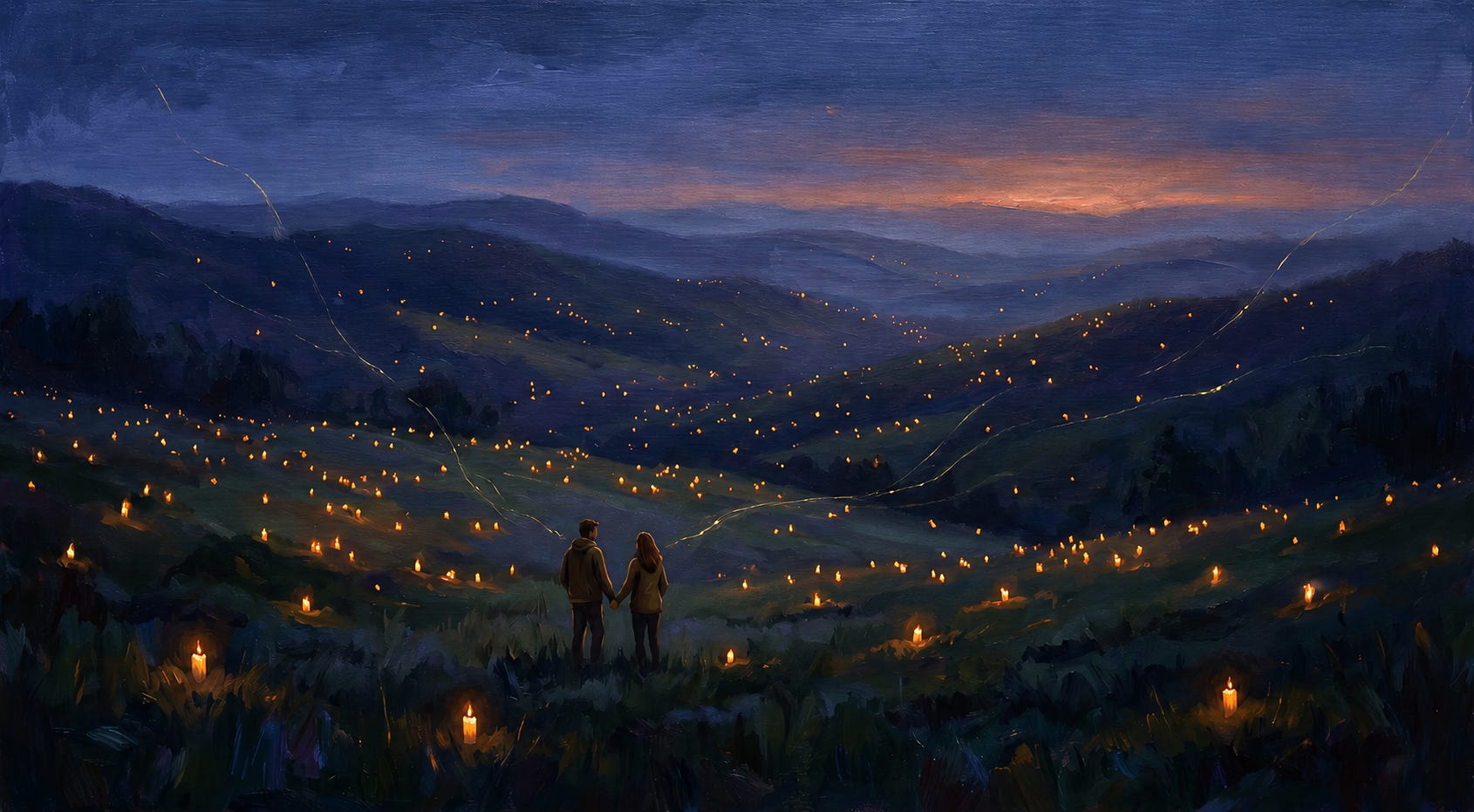
On June 20th, I’m getting married.
This will be the last thing I publish before then. I’m letting the writing go quiet as Michal and I move toward our vows and into our honeymoon, and before I step away I want to share what’s alive in me — an update about my life, and two invitations.
But to make the invitations make sense, I first want to share a little about what it’s been like to be seen by you.
I’ve been making things on the internet for over a decade. I started the Emerge podcast when I was about 28. The Emerge podcast was, on one level, about what my friend Zak Stein calls this time between worlds — where the old world system is decohering while we reach, half-blind, for the new one. But it was also about my own journey. My own dissolution. My own attempt to find my way in that liminality. And I suspect that what people resonated with, more than the content of any particular conversation, was the sincerity. The vulnerability. The genuine confusion and not-knowing, the curiosity and earnestness.
The energetics of putting yourself out there are strange. To have unknown thousands of people feeling you, seeing you, while you cannot see them — our nervous systems are simply not calibrated for this. It is, in a meaningful sense, an ahistorical situation. Nothing in our evolutionary inheritance prepared us for it.
Most people who generate an audience resolve this strange situation by armoring up. They construct a persona, and the persona is gets projected on the internet. Most of what passes for public conversation now is, as far as I can tell, personas interacting with personas to generate views.
But some of us can’t do that, because what we care about is truth, relationship, vulnerability — and the persona move forecloses all three.
My education in this was unusually intimate.
When I lived at the Monastic Academy, the podcast became the main way people found the place. They came, to some degree, because of me. They had listened to me for hours, felt resonance with my journey, felt they were accompanying me — and in a sense, they really were. But in another sense, I had never met them. And then, unlike almost everyone else doing public work, I didn’t get to keep a comfortable distance from the people projecting onto me. I lived with them. For months. For years.
It was a lot. It was often painful. And it amplified patterns of shame and hiding in me that I now see as entirely predictable — I’m writing a whole series about shame, and this period of my life is part of why I understand its mechanics so deeply. When you “put yourself out there to be seen,” your shame will come to meet the seeing. I believe this is happening, mostly invisibly, to many of us who are building in public right now.
I had to learn, over years, to meet it. I’m now much better at sensing when someone can make an object of their projections versus when they’re embedded in them. I’m better at inviting the truth of a projection out into the open. And — this is the harder part — I’ve surfaced and worked with the parts of me that were, mostly unconsciously, feeding on the projections. Seeking validation. Eating the attention.
I share all of this because it is deeply implicated in what I believe is a big part of the work of our time: non-naïve, good-faith participation in the public conversation.
And I want to say this plainly. If we are going to participate in good faith in the public conversation today, we are, in a sense, putting our lives on the line. And we should be. These conversations really matter.
For me they matter in the most concrete way I know: I am planning on having children. I need them to be safe. I need them to grow up in a world that is safe for them. Which means I need to use whatever power I have to move the world in that direction.
I’ve written a lot about what I think that world is. It is a world in which we learn to love each other — not in some facile way, but one in which we submit ourselves to the discipline of loving and being loved. Love has always functioned as the most trustworthy binding agent of human culture, and it is what will need to bind us if we are going to survive what’s coming. You might hear that as naïve. I see it as eminently practical — real and realizable, for each of us individually and for all of us together. I watch it happen every day in my coaching practice. In my view, love is the most real thing, and many people are spending their lives running from it. That’s insanity, because to run from what is most real is to disconnect from reality. What we are living through right now is, in a sense, the fruit of an insane culture — a culture that has lost the thread of reality. A return to sanity would be a return to love. To intimacy. To contact. To relationship.
This conviction is why I knowingly touched the third rail with Repent and Know Your Rank. In over a decade of publishing, those pieces generated more controversy than anything I’ve ever made. And what I discovered is that I could hold the intensity — that it was actually good for my unfolding, that it tested and refined my relationships and my work.
Which brings me to the first invitation.
For about a year now — and less directly for four years, and in some ways for much longer than that — I have been working with friends on a project called the ARC Network.
I think of it as my attempt to help create the conditions for what my friend and teacher John Churchill recently called "Occupy 2.0." I organized with Occupy Wall Street. I participated, more peripherally, in Extinction Rebellion. And in the fifteen years since, I've been picking up pieces — from my time at Buddhist Geeks, from six years of monastic training, from experiments in organizational design — trying to discover the ordering principles that would let that lightning in a bottle catch and hold. Not just spark and dissipate, as it did with Occupy, but robustly emerge and unfold until it transforms the whole of planetary culture. Not in an arbitrary direction, but toward the emergence of an intimate planetary culture.
An intimate planetary culture is one in which truly seeing each other, feeling each other, and caring together about what matters is the normal texture of everyday life — not a rare thing you find only with your closest people. It’s a world organized so that no one falls outside the reach of being known and valued.
I believe this is what so many of us are reaching for, with more or less articulacy. Our hearts are longing for it — not just for ourselves, but for our children, and for all the unborn ones depending on us to show up at this critical time in ways that allow them to live.
So what is the ARC Network, concretely?
It is, first, a network of practice — people training in something called Dyadic Unfolding, which I see as the basic atomic unit of intimate culture. Intimate culture in miniature: two people learning to love truth together. We gather around what is more than us, deeper than us, what we are both bound to — the truth — and we practice being in right relationship with it. It takes practice, given how our culture has formed us. We’ve completed our first eight-week training cohort, and we will be offering many more. Perhaps you’d like to join us for an upcoming one.
And it is, second, a network with a shared purpose: to create planetary infrastructure for the delivery of loving and attuned presence to anyone who needs it.
There is a profound and underacknowledged need, across the whole of this planet, for loving presence. It is not good enough for that to be available only to those with resources and privileged access to certain networks. It needs to be available to every single person on the planet, as soon as possible. And I believe this is a solvable problem. Loving presence is, in a sense, the most abundant resource there is — everyone has unlimited access to it in their own experience, though most of us need support and relationship to learn to receive it. The practices that allow it to flow are known. And the technology exists — both the psychotechnologies and the devices in our pockets that allow us to beam presence to nearly anyone on Earth, instantly. The intention is to coordinate the deployment of that resource so that it flows like water from a tap.
I see this not just as intrinsically good — though it is, and we ought to do it for it’s own sake — but as necessary for the world my children will need.
We’ve recently launched the first public home of the ARC Network. You’re invited to take a look, and if something in you stirs, to fill out the form. There are many ways to participate, and honestly, we are learning what this is with the people who show up. One way I like to think of it: it’s a sacred world-building improv game.
And you are invited.
→ The ARC Network ←
The second invitation is more tender.
On June 20th, I marry Michal Tolk.
As someone who has chosen to be a public person, this feels important to do: just as I am in deeply intimate relationship with Michal, I am also, in a way, in relationship with you. For most of you it’s a parasocial relationship — and it is nonetheless, in my view, a real one. One I have been cultivating. Some of you have known me, followed my unfolding, for many years.
So Michal and I want to invite you into the ritual of our vows. It would mean a great deal to us if you would hold us at the time of our ceremony. If you’d send us your blessing for our marriage — saying whatever is true for you as you consider our union. And if you feel moved to bless us with a gift, you’re welcome to do that too.
We made a page for exactly this:
→ Daniel & Michal — Hold the Ritual With Us ←
I want to end with gratitude.
I am so, so grateful that I get to live this life. To do work I love — work I can actually pay my rent with, which, for somebody with my constitution, is no small miracle. To meet the people I get to meet.
And if you think I’m impressive, or good — I appreciate that. I think I’m great too. But here is what I most want you to know: I meet people every day, through this work, who are incredible. Beautiful, creative, adaptive, loving. We are incredible.
That is what I am most interested in. Helping us see that.
See you on the other side. 💞
~ Daniel
> Planetary infrastructure for the delivery of loving and attuned presence to anyone who needs it... The intention is to coordinate the deployment of that resource so that it flows like water from a tap.
i agree with the sentiment but got hung up on the metaphor. my 2c: a better one is distributing solar panels. that's giving the capacity to orient toward and receive the love that's available wherever someone is (geographically & developmentally), e.g. inner work, relationships with others, nature. you don't ship love as a product through tubes, because it's everywhere; you teach people how to receive and cultivate it.
there's also something about localism here. water infrastructure is necessarily centralized — you need reservoirs and pipes. solar panels are distributed. the capacity sits with the individual, in their particular context. love from nature looks different than love from a friend, which looks different than love from a meditation practice. a one-size-fits-all delivery system can't honor that diversity. but a generalized capacity for receptivity can plug into whatever source is locally abundant.
Bravo; hear, hear!
To the ARC Network, a tap of loving and attuned presence, for all who need it.
And may God bless you both! To Daniel and Michal!!