
The Barely There
A generation raised on screens and starved of attunement, left feeling half-alive

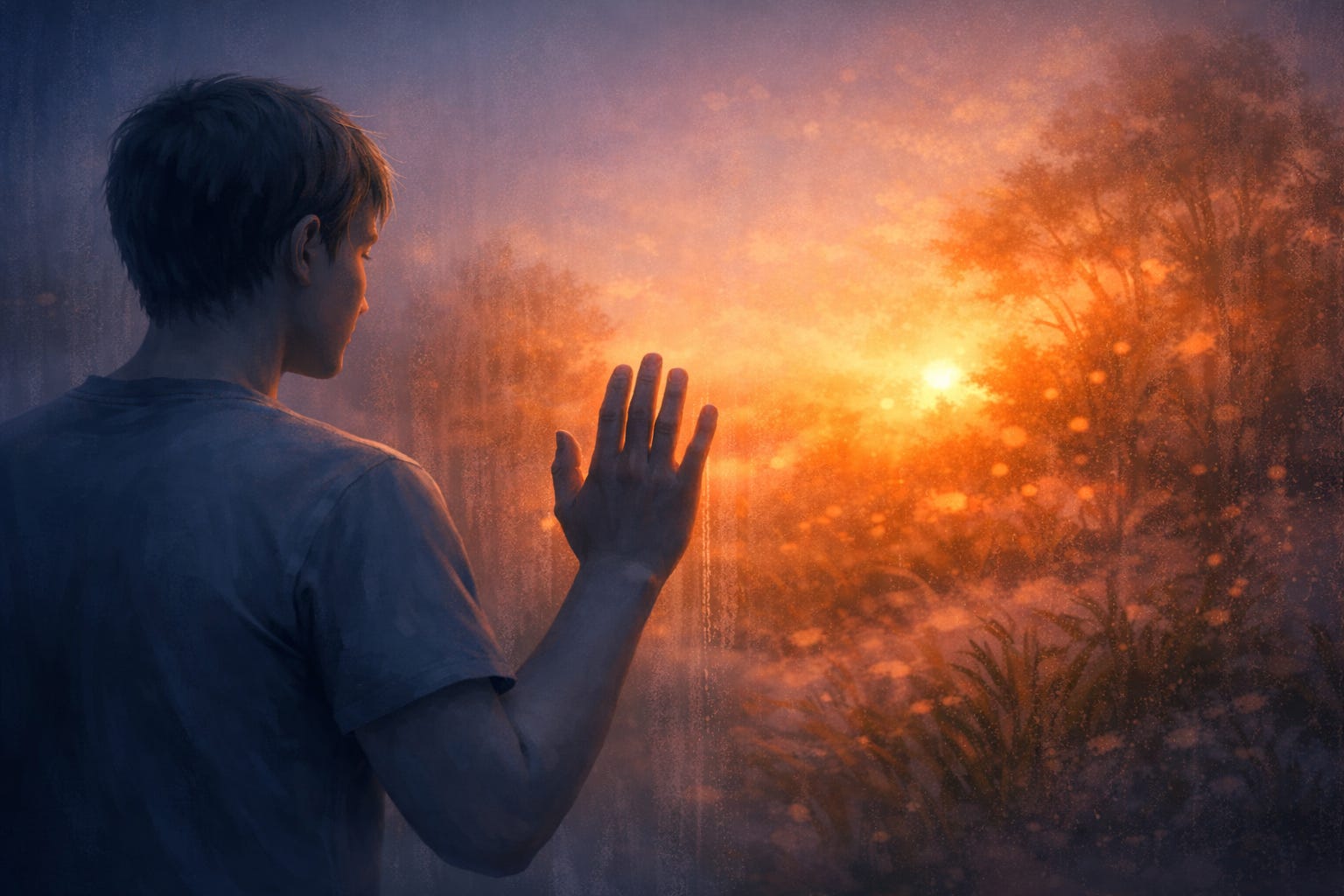
I am one of the barely there.
Or I was. Or I still am, in some way that matters—the way a recovered addict is still an addict, the way a wound that’s healed still shapes how you move.
By this I mean: for most of my life, I’ve had a weak sense of self. A poorly structured identity. A nervous system that learned early to flee from intensity rather than move through it.
I spent formative years, roughly ages ten to my early twenties, largely absent from embodied experience. I lived instead in digital worlds that asked nothing of me emotionally and gave me the illusion of connection without the vulnerability of relationship.
I’m writing this because I believe there are millions of people who share some version of this psychology. Who are barely there. Who have poorly structured identities, weak nervous systems, fragmented attention, and years they can’t remember.
Many of them don’t even know it. They think this is what being human is. They have no reference point for what it’s like to feel fully alive, fully present, fully able to be with the intensity of existence.
As a culture we are becoming more familiar with the symptoms—the loneliness epidemic, the radicalization pipelines, the addiction, the nihilism, the young men drifting through years they can’t remember—but we don’t recognize the underlying pattern: barely-there people reaching for something to make them feel real.
The Shape of Absence
The clinical term is identity diffusion—a failure of the self to cohere into stable form. In diagnostic manuals, the term is most often associated with borderline personality disorder. But it points to something more universal than any single diagnosis — a fundamental disruption in how a self holds together.
The markers are recognizable: chronic inner emptiness. A sense of self that shifts depending on who you’re with. Difficulty articulating your own values, preferences, or what you actually want. The feeling that you’re performing roles rather than living as a coherent person.
But clinical language can’t capture what it actually feels like to live this way. It feels like watching your life from behind glass. Like being a character in a movie. Like there’s a thin membrane between you and everything—other people, your own emotions, the texture of being alive.
There’s a particular quality to conversations when you’re barely there. You can feel yourself generating appropriate responses—nodding, laughing, asking follow-up questions—while some part of you watches from a distance, noting how well you’re performing “person having a conversation.” The words come out right. The face does the right things. But inside, there’s a strange hollowness, like being an expertly operated puppet who has somehow also become aware that he’s a puppet.
Growing Up Barely There
My father was fascinated by computers. He started his academic career working on those huge IBM mainframes, using punchcard systems to predict elections. I don’t remember exactly how young I was when we got our first desktop—my episodic memory of childhood is patchy, full of gaps. But I remember how the pull towards the digital occupied my days. I remember the chronic hunger to be in a different world.
Video games. The internet. Everquest. World of Warcraft—thousands of hours lost to that world alone. First-person shooters. Endless Reddit. Eventually pornography — the most intimate stimulation possible, with no other person required.
I remember sitting in school feeling the pull to get back, like an ache. School felt oppressive, pointless, the social field impossibly complex to navigate. The real world asked things of me I didn’t know how to give. The digital world felt safe.
The Conditions for Escape
The way I see it now is that technology was the escape route, but what I was escaping from was an environment that couldn’t meet me.
The human nervous system doesn’t develop in isolation. It unfolds and self-organizes in the presence of loving attunement. When a child is consistently met—seen, felt, responded to with care—their interior naturally coheres. The self emerges through this contact the way a plant emerges through soil, water, and light. It’s not optional enrichment. It’s the condition of development itself.
I grew up in a family where this attunement was scarce. Not through cruelty or obvious neglect—my parents loved me, provided for me, wanted the best for me. But they were busy. They both worked full-time jobs. They came home tired. Many evenings I sat in front of the TV, and later in front of the computer, while they decompressed or caught up on everything that needed doing.
No one knew this would matter. There was no cultural understanding that a child alone with a screen was a child whose nervous system wasn’t receiving what it needed to organize. It just looked like a kid entertaining himself, maybe even a well-behaved kid who didn’t need constant attention. The developmental consequences were invisible.
What does a child do when the relational environment can’t meet their needs? They adapt. They discover that screens don’t reject you, don’t misattune, don’t require you to manage their emotions. Digital environments offer a kind of pseudo-regulation—stimulation without vulnerability, engagement without risk. And this strategy works, in the short term. But it comes at a devastating cost: you never develop the capacity to be with difficult experience. You never build the nervous system that can tolerate intensity. And the self that should emerge through attuned relationship — the coherent, grounded person you were meant to become — simply doesn’t form.
The Bargain and Its Cost
The famous Rat Park experiments showed that rats in isolated, barren cages became addicted to morphine, while rats in enriched social environments largely ignored it.
What the researchers discovered sheds light on the relationship between environment and addiction. The isolated rats were responding intelligently to unbearable conditions. The morphine solved a problem the researchers had created by putting them in isolation.
My relationship with technology was something like this. In the absence of attuned relationship, technology became the place I went to escape the unbearable weight of being unmet.
But you can’t actually develop through escape. When you avoid contact, you don’t just miss experiences—you miss development. The self that should have been forming through relationship remains unformed.
I emerged from adolescence with a high IQ and no emotional intelligence. Sophisticated opinions and no felt sense. The ability to analyze anything and the capacity to be present with almost nothing.
We Become Through Each Other
The studies of Romanian orphanages in the 1990s reveal something about what humans most deeply need. These children received adequate nutrition, shelter, medical care. What they didn’t receive was love—consistent, attuned, human presence. The results were catastrophic: children with IQs 30-40 points below normal, severe attachment disorders, brains that showed reduced activity in regions governing emotion and connection. Some simply failed to thrive. Some died. Not from neglect of their bodies, but from neglect of what makes a body want to live.
These orphanages are the extreme example. But the same principle operates wherever attunement is scarce. Millions of us grew up in ordinary homes that were nonetheless too empty of presence—not through cruelty, just through the accumulated absences of modern life. We weren’t dying. But we weren’t fully coming to life either.
We don’t just discover ourselves through relationship—we create ourselves through relationship. The self forms through intimate participation with others. Each moment of genuine contact calls us further into life.
When that contact isn’t available, we become half-alive. Because this is simply how humans work.
The Shame of Seeing It
One of the hardest parts of recognizing all this—at least when I first began to see it clearly—was the shame.
A dear friend once told me about how his two-year-old daughter behaved at daycare. When another child was dysregulated—crying, overwhelmed—she would move toward them. Not to fix or distract, but simply to be with them. Her little nervous system already knew how to offer presence to someone in distress.
He and his partner are raising her with all of this in mind. They spend hours in deep regulation with her. They tend to her nervous system the way you’d tend a garden—patiently, consistently, knowing that what they’re growing will take years to fully emerge. They’re giving her what I didn’t receive.
Hearing the story, I felt the gap in my chest like a physical thing. Here was a two-year-old more capable of attuned presence than I was at 28. At 32. Maybe even at 35. She was being raised in the field of love that allows these capacities to naturally develop. This is what ordinary childhood looks like when the conditions are right.
Seeing this clearly was devastating. I had spent so many years training my attention to fragment rather than deepen, learning to flee from intensity rather than move through it. And now, in my thirties, I was trying to build what should have been built in childhood while already living an adult life—relaying foundation while the house was standing.
The Wound That Opens
And yet the wound carried its own strange gift. The very absence that stunted my development created a hunger—a need so profound that it became a kind of forcing function.
When you grow up without something essential and then begin to recognize its absence, you can’t take it for granted. You have to fight for it. Study it. Learn to cultivate what others may have simply inherited.
And sometimes—not always, but sometimes—this means you end up going deeper than those for whom it was always just the water they swam in.
I’m 38 now. I coach people who are navigating exactly what I’m describing—the barely-there mind, the weak nervous system, the identity that never quite cohered. I help them come to life, find their way into intimacy with reality and relationship.
And the intimacy I experience now with my fiancé is a depth and quality of connection I never imagined. More than I saw modeled in my parents’ generation. More than most of what I see around me.
This isn’t because I’m special, it’s because I had to learn. The absence demanded it.
And somewhere along the way, I stumbled into a strange recognition: what I was finding my way towards wasn’t some new achievement. It was simply how humans used to be together.
Anthropologists studying pre-industrial cultures found something remarkably consistent: infants held in near-continuous bodily contact, their needs met before distress had to escalate, their nervous systems developing inside a constant field of attuned relationship. These children grew into adults capable of seamless, empathic coordination—their individuality and their communion somehow fused. This is simply what unfolds when humans are raised in the field of love their nervous systems evolved to expect.
The barely-there mind is what happens when those ancient conditions are stripped away. And those of us who grew up in the absence—who know in our bones what it costs—may be the ones most motivated to reclaim what was lost. Not just for ourselves, but for what human culture could become again.
What Love Actually Is
The path forward is love — though that word has been so hollowed out I need to be specific. I mean something closer to what a womb is for a fetus: the environment in which a human being can come into existence at all.
Love in this sense is an atmosphere you exist within, a relational field that allows a nervous system to organize, a self to cohere, a person to come to life. It is a steady, reliable presence—attuned, available, undistracted. It is the experience of being seen and held without needing to be different.
Healing follows the same logic: it happens through existing within that field. Through relationship with people who can genuinely be with you, who don’t need you to perform, who can stay present while you learn to be present with yourself.
People are made through love. Its absence leaves us half-made. And its return, even late, can finish what was left incomplete.
A Strange Time to Be Alive
We live in a strange moment. The world is asking more of us than it ever has—more presence, more capacity, more tolerance of complexity, more willingness to face the truth. And yet the conditions that would allow us to meet these demands are precisely what’s been stripped away. We’re being asked to show up fully in an era that has systematically produced people who can barely show up at all.
There’s a cruel irony here. The same forces that created the barely-there mind—the screen saturation, the attunement scarcity, the relational poverty—are intensifying. The children being raised right now have it worse than I did. And they’re inheriting a world that will ask even more of them.
Without people around us calling us into being, it becomes easy to abide in dissociated limbo. The half-alive state. The zombieland of scrolling and consuming and deferring. Why wake up when waking up means feeling the weight of everything?
And yet. The aliveness itself is what allows us to meet the weight. The capacity to meet the world comes through the engagement, through relationship—we become strong enough in the process of showing up, not before it.
This is the invitation hidden inside the wound. The very absence that made us barely there is asking us to discover what it means to become fully here. Not alone. Together. Through the only force that has ever made humans human: love.
If This Is You
If you recognize yourself in any of this, I’m not going to tell you it’s easy. It’s not. You’re being asked to build in adulthood what ought to have been built in childhood, and some days that feels impossible.
It’s like learning to walk after a long paralysis—the muscles are weak, the balance is off, and there are countless falls. Some days you’ll wonder if you’re making progress at all. And then a wave of grief will hit — the gap between where you are and where you sense you could be — and it will be almost unbearable.
But the self that didn’t form in the absence of love can still form when love arrives. I’ve watched it happen in my own life. I’ve watched it happen in the lives of people I work with. The nervous system is more plastic than we imagine. The identity that didn’t cohere can still cohere. What was frozen can move.
I won’t pretend I know exactly how it will happen for you. The healing is relational, and relationship takes many forms. A therapist. A friend who won’t let you disappear. A partner who stays. The slow interior work of offering yourself what you never received. Some combination of these, in an order that only your life will reveal.
And then, without quite knowing how, you may find yourself in a moment of genuine contact—with another person, with your own body, with the texture of being alive—and something in you will recognize it. This. This is what I was looking for all along.
Those of us who grew up in the absence are not doomed to stay there. The hunger that drove us into escape can become the hunger that drives us into life.
Philosophical foundations: This piece draws upon several wisdom traditions explored in my Lineages of Inspiration article, which outlines the key influences shaping my understanding of human transformation.
Work with me: I offer one-on-one guidance helping people develop secure attachment with reality through deep unfoldment work. If this resonates, explore working together.
Hi Daniel. I have been a big fan of your podcast, and was also in the first level training of Planetary Dharma with you. I want to tell you that I feel that the radical transparency and courage that is now being transmitted through your voice here feels rare and valuable. It feels like some kind of turning, a sacred reversal, in which you who listened so beautifully to so many people for years, are now allowing your own unique and irreplaceble voice to find its place in the world. I celebrate this, and I give thanks.
This is amazingly and poignantly written. Even though I am much older and not a child of screen time the symptoms of emptiness and inability to be fully present as well as an inability to remember childhood clearly, are the same for those of us who had to live through childhoods where trauma was present. Be it that our parents experienced undiagnosed post war trauma and therefore could not fully be present for their children, but also as a child who experienced the fallout of living in a household of psychiatric disorders, and therefore with my own trauma. I am only sorry to hear that younger people are going through this from a very different source. But I have always suspected this to be true as I watch society, with people buried in their devices and not communicating with an actual human beside them. It is especially heartbreaking when that is a child seeking their parent’s attention.
May we all strive to heal as this author has so we can be more fully there for others.
Thank you for your courage and this beautifully written peace.